
Why we hate CUBES
And what to use instead

I don’t mean the shape - cubes are perfectly lovely, mathematically satisfying shapes, especially when you get to stack them.
What I’m referring to is a “close-reading protocol” that’s often used in math classes. As far as I can tell, it teaches students to do a whole lot of busy work rather than make sense of the problem in front of them.
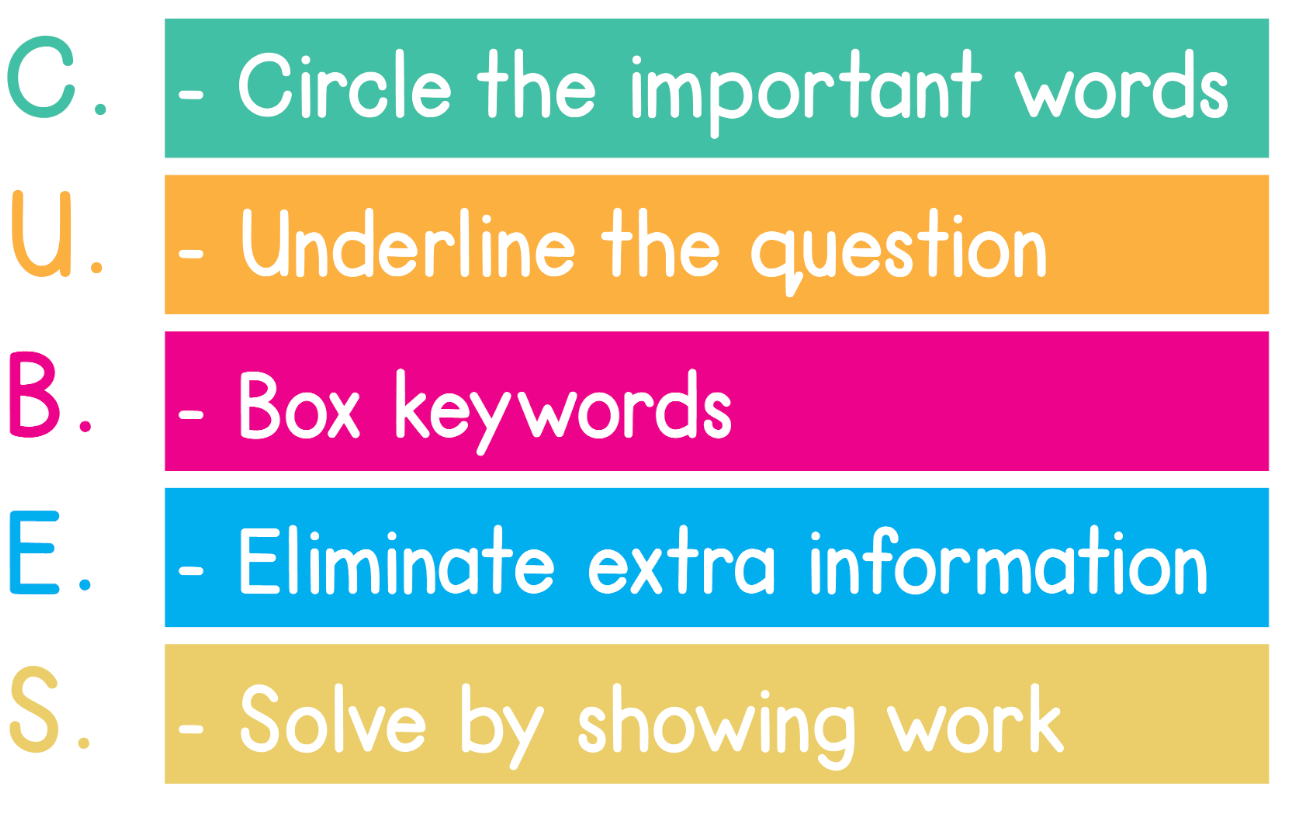
Image from Maneuvering the Middle (where there’s even a note saying “With all of the annotating of the problem, I’m not sure that students are actually reading the problem. None of the steps emphasize reading the problem but maybe that is a given.” No, it’s not a given! This gives them lots of busy work and misses the whole point of reading!)
The myth of CUBES as a useful strategy has been debunked before (see Robert Kaplinsky’s analysis and counter-strategy here, for example), and, thankfully, I haven’t seen a whole lot of CUBES in the past few years. Many schools have pivoted to using the Three Reads Protocol, which is included in high-quality instructional materials like Illustrative Math. Our reading issues are solved, right? No more struggling with word problems! Nope. Despite its thoroughly researched foundations, many schools have figured out how to bastardize the Three Reads, reducing it to busy work as well.
For those who haven’t heard of it, the Three Reads protocol asks students to read a problem three times, with a different focus on sense-making each time. There are slight variations in how this is done, but most play out something like this:
During the first read, students try to make sense of the scenario. What is this problem about? Can you explain to a classmate what’s happening here, what this scenario is?
On the second read, students focus on the quantities. What are we measuring here? What can be counted or quantified? Are we talking about eggs? Miles run this year versus last year? Something else?
By this time, students should have a solid understanding of the situation. They have had the chance to make sense of the scenario, to flesh it out with peers, to make a mental picture or act it out, to ask clarifying questions if they need to. They may even spend a minute predicting what mathematical question will be asked (or to co-craft questions). Students then read the problem a third time to focus on the question: what are we actually being asked to figure out?
All of this is done before students start solving. It’s effective because it helps students make sense of what they’re reading, rather than pulling some numbers from the problem, performing some operations (often not the right ones) and hoping they answer the question. As an experienced test taker, you and I might do something like the Three Reads without even realizing we’re doing it. We read a question to make sense of it, maybe making a mental picture of the scenario; we read it again to re-focus on the quantities; and finally we make sure we know what the actual question is.
Some, however, have bastardized the 3 Reads and essentially “CUBE-ified” it, as one of my brilliant colleagues, Kathy Blozy, pointed out the other day.
A CUBEified Three Reads protocol might look like:
Read the problem for the first time and circle the quantities.
Read the problem again and underline any key information.
Read the problem a third time and box the question being asked.
Yesterday, I watched a class of twenty-two 9th graders dutifully circle, box, and underline a word problem. They did exactly what the protocol outlined. When it came time to actually solve the problem, only one student proceeded to try it. Twenty-one others sat there with blank stares, put their heads down, or fiddled around with their calculators pretending to look busy. They had done what they were told to do, but they had not made sense of the problem.
So why do schools still insist on pushing strategies that obscure actual thinking? Why do they take something as rich as the Three Reads and whittle it down to a rigid procedure? Schools face very real problems: many students struggle with reading comprehension, and (a surely related phenomenon) many students dread word problems and tend to skip them on standardized tests. A concrete strategy like CUBES provides a measurable outcome (did 22 students box, circle, and underline the problem? They sure did). A school or district administrator might come in the room and see students hard at work doing something, and they can check off a box saying the teacher used a close-reading protocol and students were all engaged. Even if the students understood next to nothing about the problem.
Measuring whether a student read and comprehended a word problem is much trickier than seeing if they circled, underlined, and boxed some words. It’s a process that, like most good learning, is complicated and messy. The clearest evidence that a student read and understood a word problem comes from listening to them discuss it and watching them solve it. (Sounds remarkably like good math instruction!)
This is exactly what the Three Reads protocol does. By forcing students to discuss the scenario, to re-look at what is being measured, to anticipate what questions might be asked, we force them to make sense of the problem. And if they don’t comprehend it, the protocol gives them the opportunity to ask questions and get clarification. It’s not a compact, neat process that an outside observer can quantify. But it works.