
Thinking Negatively
and why we should disregard the rules


“She couldn’t solve the problems, but she wouldn’t use the reference sheet I gave her either. I don’t know what to do – I gave her all the rules she needs to know!”
I listened to a teacher today describe how he had attempted to help students with signed number operations (adding, subtracting, multiplying, and dividing negative and positive numbers) by giving them a reference sheet of the rules. He detailed how the list of rules didn’t seem to help students who were already struggling with this content, and the ones who weren’t struggling didn’t need the list of rules.
“What rules is he talking about??” I was thinking to myself. I’m a math coach with a degree in educational leadership; I got a near-perfect score on the math portion of the SAT; I tutor second grade through calculus. But I could not figure out what rules he was referring to.
Sure, I know the rules for multiplying and dividing negative numbers: a negative number times a negative number equals a positive number; a negative times a positive equals a positive; and (of course) a positive times a positive equals a positive. But what were the other rules he referred to – the ones for addition and subtraction?
I remember having this exact conversation with another teacher (an excellent teacher whom I greatly admired!) about ten years ago. He described to me how, even if you allow for exploration and discovery of operations with signed numbers, ultimately you want students to memorize the rules. I tried to convince him that I, the school math specialist, didn’t know what rules he was talking about and had in fact never thought about adding and subtracting using rules. He insisted I was wrong. Surely I had the rules so internalized that I didn’t realize they were helping me solve problems. No, really, I don’t know the rules and I never have.
I promise you that I can add and subtract integers fluently. I’ve just never thought about what I’m doing in terms of rules.
So now I’m googling: what are the rules for adding and subtracting signed numbers?
Google’s AI overview says: “If signs are the same, add [the numbers’] absolute values and keep the sign. If signs are different, subtract the smaller absolute value from the larger one and take the sign of the larger absolute value.”
I definitely don’t think about absolute value when I’m combining numbers. I do picture a number line, so maybe you could argue that I’m thinking about distance from zero, but I’m not using any formal understanding of absolute value.
One charter school’s website describes the rules for addition like this1:
same signs = add the numbers, and keep the same sign (Ex: 3 + 2 = 5 or -3 + -2 = -5)
different signs = subtract the numbers, and keep the sign of the bigger number
Subtraction gets more complicated:
Change the subtraction sign to an addition sign
Then change sign of the second number
Finally follow the addition rules to get your answer
Example: -3 – 2 = becomes -3 + -2 = or 3 – -2 = becomes 3 + 2 =
It then goes on to say students should write these rules on an index card and use that index card as a support until the rules are memorized.
I’m putting forth an argument here that asking students to memorize these rules is exactly what makes them confused. That same web page starts off by saying that combining integers (it really means signed numbers) “is a field that most children are unable to grasp.” They’re unable to grasp this because we’re making this way too complicated by asking them to memorize rules! [Also, I’d like that author to see my post on the power of expectations.]
My debate with the teacher ten years ago continued with him asking me how, if not by following rules, I approach these problems. I replied with something along the lines of “I just think about them. And usually I picture a number line.”
That’s right, I make a mental picture of a number line pretty much every time I add and subtract negative and positive numbers. “How inefficient!” some teachers would say (and have said). Setting aside the argument that efficiency can only be defined by what works best for each individual, I would argue that it is way more efficient than the methods described above because I’m thinking conceptually about the numbers and operations.
Let’s use the same example as above: -3 - 2. I think about this as starting at negative three on the number line. Then I take away (positive) 2, which means I’m moving to the left, or more negative. If we think about this as money, a useful analogy for students, -3 would mean I owe someone $3. Then I spend $2 on something (using a credit card, presumably!), which means I’m now in the hole $5. This is the same as the problem -3 + (-2), but I didn’t have to change the signs. I know that taking away 2 means moving left on the number line.
Let’s make it more complicated: -3 - (-2). I’m taking away a negative, which really means I’m adding; it’s like someone is erasing $2 of my debt. So now I’m only in the hole by $1. On the number line, I can picture the minus sign telling me to move left, but the negative sign negating that. If I move left a negative amount, I end up moving right.
How about when the problem asks us to add two negative numbers? For -3 + (-2), I know that I’m combining negative numbers, so my sum is going to be more negative. I don’t think about the absolute value of both numbers, add those absolute values, then randomly stick a negative sign on at the end. I think about each number as if they are tangible quantities that I’m adding. I guess you could say I’m treating them as if they’re positive numbers (hence, taking the absolute value), but I’m really not thinking about them that way. I’m thinking three negatives and two more negatives makes five negatives.
What about when the numbers are bigger (or further away from zero)? Ok: -39 + 54. The “rule” says I could subtract the smaller absolute value from the larger absolute value (so 54-39), then use the sign of the larger one, getting us to 15. I actually picture a number line in my head:
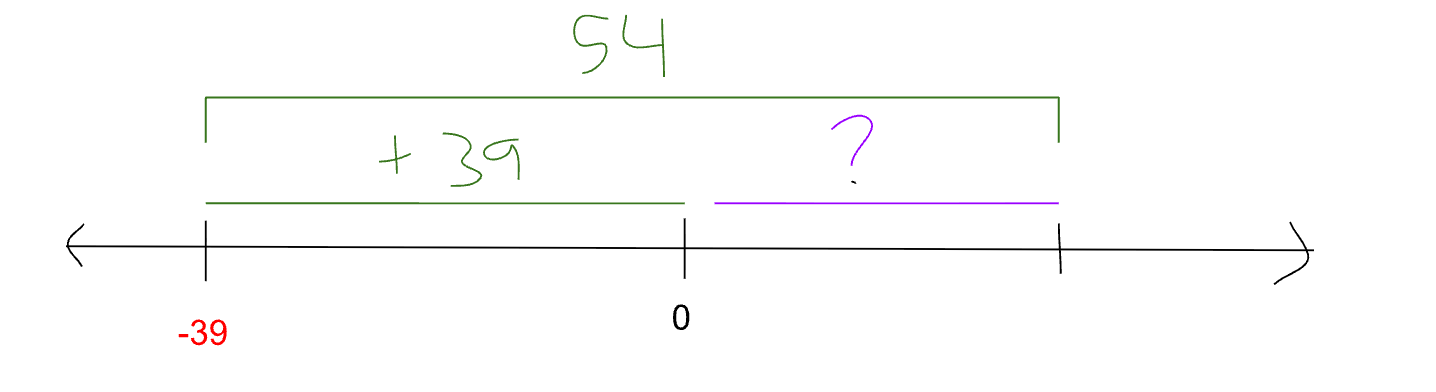
I know that -39 + 39 gets me to zero (a nice friendly number), so then I have to figure out how much is left of the 54 I’m trying to add. Another way to think of it is I decomposed 54 into 39 and another part, and my job is to figure out what this part is. Knowing that addition is commutative (but, importantly, subtraction is not!), I could also rearrange this to be 54-39. Yes, this means finding the difference between 54 and 39, and all of these strategies are equivalent to finding the absolute value of both and then subtracting. But I’m picturing the numbers on the number line and manipulating them in a way that’s helpful. I’m not blindly following a rule.
It’s fascinating to me that it’s a peculiarly American thing to make a distinction between the negative sign and the subtraction sign. Most other countries refer to -6, for example, as “minus 6,” which collapses the distinction (and there is a distinction, as well as significant debate, about it, for mathematicians. For some light reading, see here and here). This actually makes a lot more sense to me, since the negative sign and subtraction function almost identically.
Much of the difficulty of understanding negative numbers, I suspect, comes from how we learn to count using concrete objects. A negative number is an abstract concept, and whether or not it’s a valid answer depends on the context of the problem (which the math doctors described beautifully).
Tools like a number line and algebra tiles help put negative numbers into the world of the concrete. We can visualize where they are, see how they operate, and manipulate them as if they were objects in front of us. If we can visualize what’s happening when we add and subtract negative numbers, maybe we don’t need all of those rules.
And isn’t that always the case? That if we truly understand what we’re doing in math, we don’t need to memorize the rules?
One of my strengths is cutting through bullshit to see and describe complicated things in simple terms. My brain likes to boil things down to their essence. Sometimes, though, I oversimplify something that shouldn’t be simplified. So please, if you disagree with me on this, leave a comment, and let’s discuss it!
I’m not citing this because I don’t want to be that rude. Also, I don’t know their students, so who knows, they might have a really good explanation for why this on their website.
This was such a great read!! I haven't done work adding and subtracting signed numbers in a long time, but thinking about subtracting a negative as erasing debt makes so much sense!