
The Nines Trick
And why maybe your fingers are magical

Last week I wrote about two tricks for multiplication using your fingers, and insisted that what looks like magic isn’t magic but just math being math-y. This week I’m writing about the nines trick, and how maybe our fingers are actually magical.
While the sixes trick is kind of obscure (I had never heard of it until my friend sent me an Instagram reel of a young girl doing it), the nines trick is ubiquitous. A lot of kids even learn it in school from their teachers, who no doubt want to help their students remember their pesky nines facts. Here’s that same girl demonstrating it.
A quick recap: Hold up your two hands with fingers extended. For whatever number you want to multiply nine by – the multiplier – fold down the corresponding finger. The number of fingers left extended to the left of that represents the tens; to the right represents the ones. For 9x6, for example, bend your 6th finger, and you’re left with 5 tens and 4 ones: 54.
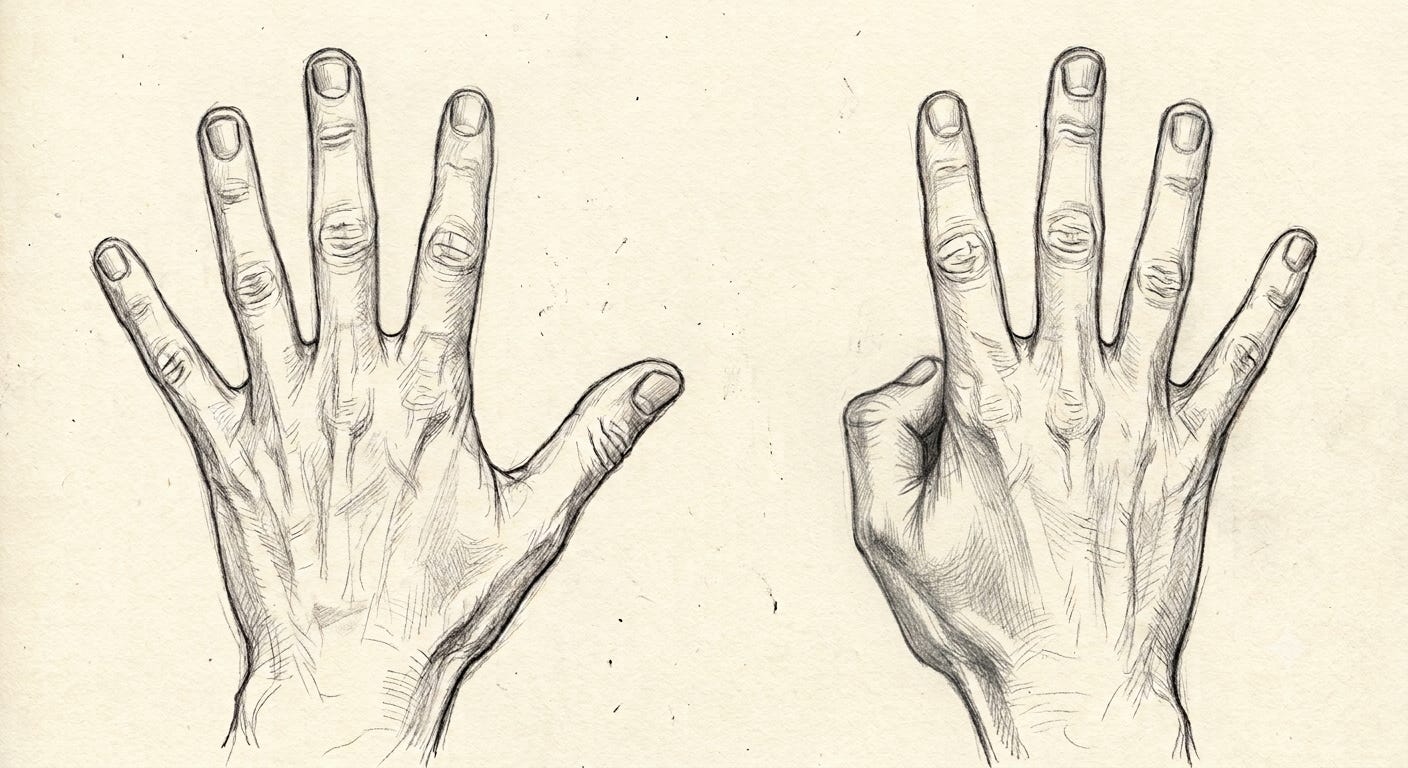
If we skip-count by tens on our ten fingers, we get to 100. When we fold down our 6th finger, we’re effectively saying we know 9x6 is one less ten than 10x6. So rather than 60 as our tens, we’ve got 50. Then we switch to counting our fingers as ones. 9x6 is six less than 10x6, so subtract six of your fingers – i.e. bend your 6th finger and count only what’s to the right of that – and you’re left with the ones: 4.
This works for every single-digit multiplier of nine. And there’s a similar version for multi-digit multipliers that I may explore in a future post.
If you liked the equations showing how the sixes and fours tricks worked, here you go:
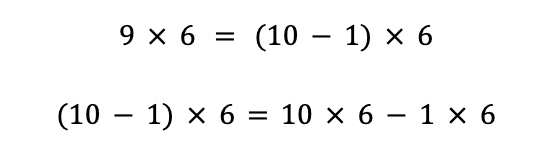
What our fingers represent doesn’t line up with the equation quite as cleanly as the sixes trick did because our fingers represent two different bases simultaneously. Starting from the left, our fingers represent tens, then, on the other side of the folded down finger, they represent ones.
The beauty here – or the magic, if you will – is that our number system uses base 10, and we have ten fingers! And that is not at all by coincidence, as far as we can tell. (Here’s a decent explanation of the base 10 system if you’d like to read more.)
Imagine how hard it would be to use our fingers for tricks like this if we used a base 6 or base 12 system. (Kinda sounds like a fun exercise to me, actually…)
Next time, we’ll look at the elevens trick that makes you look faster than a calculator.
Here's another version of this that looks like a trick, but it's actually just "math being math-y" https://www.youtube.com/shorts/SIP0O7i-inc