
Boxed Into a Corner
The reality in many schools right now and what to do about it

In a statement released in March of this year, Latrenda Knighten, president of NCTM, offered this guidance: “A preplanned lesson plan can provide a strong foundation, but effective mathematics teaching requires flexibility, reflection, and responsiveness.” For the past few years, I have worked with teachers and principals in NYC using High-Quality Instructional Materials (HQIM) for possibly the first time. I support them to understand the depth and breadth of the material, to adapt it to meet their students’ needs, to use it to prepare students for the ultra-high-stakes Regents exam that determines whether or not they graduate from high school.
I read the NCTM statement and thought: Yes! Of course teachers need to be flexible. Of course they shouldn’t blindly follow a script. Of course HQIM “can provide structure, alignment, and consistency, [but] they should not replace professional judgment.”
BUT.
The problems I see in schools run so much deeper than how the teacher uses the curriculum materials.
Yesterday morning, I chatted with a teacher during her poorly attended first period class. The one student that was there, a teenager who recently arrived in the U.S. from the Dominican Republic, spoke only Spanish. The teacher engaged her with a task (in Spanish – pretty much a requirement in this part of the Bronx) and got her started on a few practice problems. The girl worked diligently, asking for help whenever she needed it. No other students were there for her to work or discuss her ideas with.
When the bell rang and the student left, the teacher told me, “That girl was in 4th grade in the Dominican Republic.”
She came to the U.S. recently and was placed in a high-school Algebra 1 class because that’s where her age (15 or 16) determined she should be. She is supposed to take the Regents exam, which determines whether she can graduate from high school, in a few weeks.
Imagine missing all of the math you learned between 5th grade and Algebra 1. You would never have been taught:
Most of what you know about fractions and decimals
Everything you know about percents
Everything you know about ratios, rates, scaling, and comparing units
That negative numbers exist
Most of what you know about shapes, angles, symmetry, and measurement
Most of what you know about factors, multiples, and division
How to use a calculator for basic operations
What a variable is
What a coordinate plane is and how to represent relationships on it
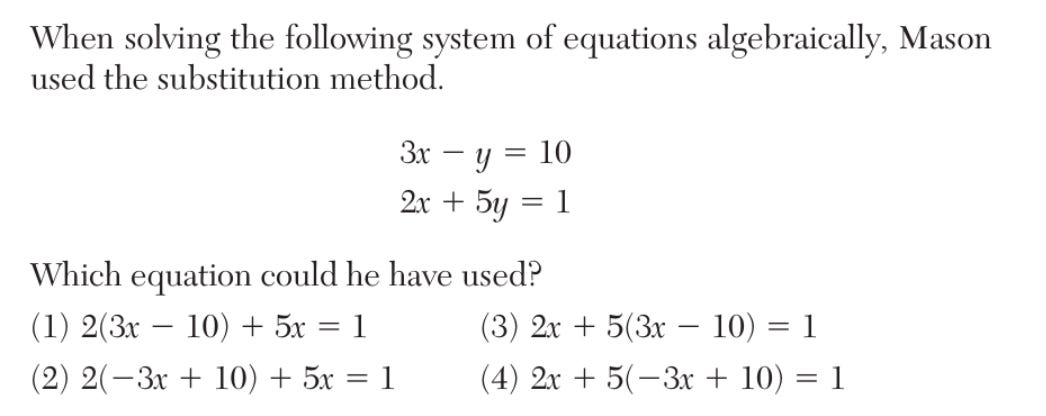
Now imagine you are given a problem like this and told you can’t finish school unless you get enough of these correct:
Finally, imagine you’re the teacher of that child. Here’s the rest of the situation you’re facing:
Most students don’t show up to first period. I don’t mean some; I mean most. Classes have fifteen to twenty students registered, and there are just two you can count on to be there when the starting bell rings. A handful more usually trickle in through the period. The schedule is the same every day, so this means many students miss the same class every day.
Math classes are 42 minutes long, and there are no intervention periods. The instructional materials (the HQIM you’ve been told to use) were designed for 60-80 minute blocks.
Many, if not most, of your students test well below grade level in math and reading.
You are evaluated by your principal on how well your students perform on the Regents exam and on how closely you follow school mandates. These evaluations determine whether or not you can keep your job.
Your principal is evaluated on how well your students perform and how closely you follow district mandates, like using the new high-quality curriculum. So they pressure you to stick to the pacing guide, to follow the script, to do as you’re told rather than as you, in your professional judgment, deem appropriate for your particular students.
This is the situation in most of the schools I support. High-quality instructional materials alone will never solve these problems.
So then, if you are a teacher in this system, what do you do? What does work? What gets you out of the corner you’re feeling boxed into, where you want to break through a wall and escape teaching forever?
Here’s a short list:
FIRST: Work on building a culture of safety and risk-taking, where mistakes are learning opportunities, from Day 1.
Related: Build relationships with the students. Get to know who they are, where they’re from, what you can do to support their learning. Feeling safe, seen, and valued are prerequisites for learning.
Then: Get the students writing. Every single one of them. They can write in whatever language they’re most comfortable with, however much or little, but they need to be actively engaged in thinking, not sitting passively while class plays out in front of them. Writing doesn’t necessarily mean they’re thinking, but it is a pathway to better engagement.
And also: Get the students talking. Every single one of them. And remember that they need to feel safe (see point 1) before they talk.
If you’re an administrator:
Allot more time for each core subject, as well as intervention blocks where students can get the support they need. These are critical. Having students who never finished 4th grade sit through forty-five minutes a day of Algebra without addressing all those years of schooling they missed is not going to magically catch them up. Recent research from TNTP shows that just-in-time intervention can boost students’ success with Algebra.
Rotate the schedule. Some (not all!) students are late every day through no fault of their own. Give them a chance to learn that subject rather than having it first period every day.
In a building with multiple other schools (as many in NYC are now) and feeling like you can’t change the schedule? Meet with those other school leaders to strategize over how you can address these issues together. I guarantee you they are facing similar struggles.
So yes, HQIM are important, but they are only one piece of a very complex puzzle.